
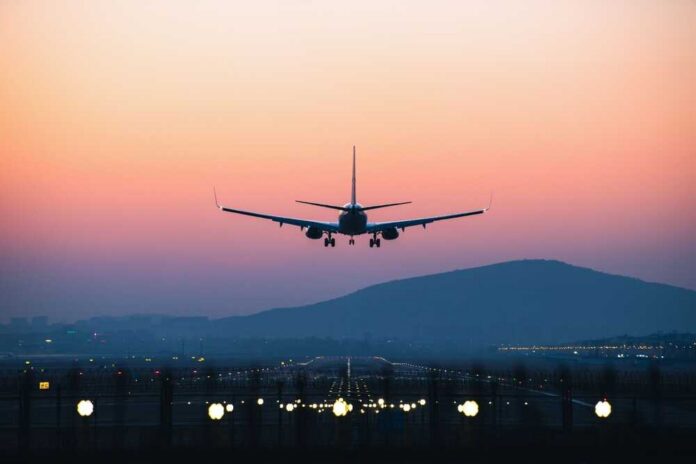
The most unsettling part of the JetBlue drone scare is not what we know, but how little anyone can prove.
Story Snapshot
- A JetBlue pilot radioed that his jet “collided with a drone” at 3,000 feet on approach to JFK.
- The Federal Aviation Administration (FAA) and JetBlue pulled the jet from service and inspected it.
- Inspectors found zero damage and “no evidence of a collision,” despite the pilot’s detailed claim.
- If confirmed, this would be among the first alleged drone hits on a US passenger jet, yet it may never be proven.
A Pilot Says His Jet Was Hit By A Drone Over New York
JetBlue Flight 948 from Las Vegas was descending toward John F. Kennedy International Airport around 7:15 a.m. when the pilot broke the routine calm of final approach with a sharp report to air traffic control.
He said, very plainly, “We collided with a drone back there in the turn… it hit us right above the cockpit” at about 3,000 feet over the coastline. The Airbus A321 continued toward JFK and landed minutes later without needing special assistance.[2][6]
Federal Aviation Administration controllers treated the call as serious. A drone flying at 3,000 feet in restricted airspace over one of the nation’s busiest airports is not a minor nuisance; it is a violation and a potential crime.
The Federal Aviation Administration confirmed the report publicly and said the incident occurred roughly 10 to 12 miles from JFK, near the beach community of Sea Bright, New Jersey. That detail matters because it means the reported drone was not hovering right over the runway, but still squarely in protected airspace.[2]
Inspectors Find No Damage And No Proof Of Impact
After landing at 7:21 a.m., JetBlue did what you would expect from an airline that knows how quickly a safety scare can spiral into legal and political trouble. Customers got off normally, and the airline pulled the jet out of service for a post-flight inspection.
JetBlue’s communications team later said the inspection “found no damage or evidence of a collision.” The Federal Aviation Administration echoed that conclusion: both the agency and the airline agreed they saw nothing on the aircraft that proved it had been struck.[1][2]
A JetBlue pilot reported their plane possibly struck a drone at 3,000 feet while on final approach to John F. Kennedy International Airport. The plane landed safely, and all passengers were able to exit normally. https://t.co/OirVItoMia pic.twitter.com/JlqKgCnToK
— CBS Evening News with Tony Dokoupil (@CBSEveningNews) June 29, 2026
This clean inspection is the pivot point of the whole story. On one side, a trained pilot, used to spotting threats in a cluttered sky, insists something hit his plane above the cockpit.
On the other side, engineers and mechanics look over the jet and find no dents, no cracked composite panels, no scuffs, no loose hardware, nothing.
The Bigger Pattern Of Unverified Drone Strikes
This JetBlue case fits a small but important pattern in modern aviation: pilots occasionally report drone strikes that maintenance teams cannot confirm.
In 2024, a United Airlines pilot landing in San Diego also reported hitting a “red shiny object” he believed was a drone at about 4,000 feet; a thorough inspection later found no damage and the plane went right back into service.
That story echoes what happened over New York almost detail for detail, right down to the Federal Aviation Administration investigation and lack of physical proof.[11]
Policy research on consumer drones and air safety drives the point home further. One major review of drone risk in United States airspace concluded that, to date, no commercial drone or hobby quadcopter has ever been conclusively proven to have collided with a manned aircraft in United States skies.
That does not mean drones are harmless. It means the confirmed record of actual hits is extremely thin, while the record of reported near misses and suspected strikes is much thicker and more emotional.[8][12]
Risk, Responsibility, And What Common Sense Says
Aviation testing shows what a real drone impact could do. Studies and lab tests suggest even a mid-size quadcopter can shred jet engine fan blades in a fraction of a second, damage radar systems in a plane’s nose, or embed its battery inside a structure and start a fire.
A suspected drone strike in Tijuana, Mexico, produced visible nose damage on a Boeing 737 and disrupted its communications gear. Those examples help explain why pilots react strongly to anything that looks or feels like a drone close to their aircraft.[14]
🚨 #BreakingNews 🚨
"JetBlue Flight 948 Reports Mid-Air Drone Strike on Final Approach to JFK Airport; FAA Launches Investigation After Airbus A321 Lands Safely With No Damage"
➡️ JetBlue Flight 948, an Airbus A321 traveling from Las Vegas to New York City, reported a direct… pic.twitter.com/eD8E5UxxIw— BreakinNewz (@BreakinNewz01) June 29, 2026
From a rule-of-law view, the stakes are clear. Flying a drone at 3,000 feet in restricted approach paths is illegal and reckless, and drone operators who violate those rules deserve serious penalties.
At the same time, punishing someone based on a report without physical evidence runs against basic fairness. The JetBlue incident, like the San Diego case, shows the gap between fear and proof. The pilot’s word deserves respect, but policy should rest on data we can see, measure, and test.[10][12]
Why This Strange Case Still Matters
Drone collisions with airliners remain extremely rare, but the number of drones in the sky keeps growing. That tension forces a question: how many of these “we hit a drone” stories are real, and how many are honest mistakes in a stressful cockpit?
The JetBlue flight landed safely, the jet showed no damage, and yet the Federal Aviation Administration still has to investigate as if this might be one of the first proven hits in United States passenger aviation. The truth may stay in a gray area that never fully satisfies either side.[2]
For travelers, the takeaway is simple but uneasy. The system worked this time: the pilot spoke up, controllers listened, the airline inspected, and no one was hurt.
Yet the case exposes how modern air safety now depends not only on pilots and mechanics, but on thousands of hobbyists and commercial drone operators whose choices can put hundreds of strangers at risk. When reports clash with evidence, we find out if our institutions can keep their heads clear and stick to facts, even in the shadow of a scare.[1]
Sources:
[1] Web – JetBlue flight reports striking drone while landing at JFK
[2] Web – What happened to JetBlue Flight 948? FAA investigates reported …
[6] X – JetBlue flight 948 reported hitting a drone at
[8] Web – A JetBlue Airways pilot reported hitting a drone as the flight was …
[10] Web – A JetBlue flight struck a drone while approaching John F. …
[11] Web – JetBlue pilot reports hitting drone while landing at New York’s JFK
[12] Web – DRONE STRIKE REPORTED at JFK Airport 29 JUN 2026 – Instagram
[14] Web – JetBlue aircraft strikes drone on approach to New York JFK A …